
What paint is safe for pets indoors in Sydney? Here’s your straight answer: zero VOC or low VOC water-based acrylic paint is the safest choice for homes with dogs and cats, with ECOS Paints, Dulux Low VOC range and Taubmans Endure the top recommended options for Sydney pet owners in 2026.
At Brushworks Painters, we paint dozens of Sydney homes with pets in residence every month. We understand the anxiety that comes with repainting when you’ve got a curious Labrador or an overly dramatic cat who treats your freshly painted walls as a personal scratching post.
- Best overall pet safe paint: ECOS Paints, zero VOC, used in animal shelters
- Best for cats and dogs: Dulux Low VOC range, low odour acrylic
- Best pet safe wall paint: Taubmans Endure Interior, washable and low odour
- Best natural pet safe paint: Bio Paints natural mineral paint, no synthetic chemicals
- Best for pet rooms and kennels: ECOS Pet Dwellings Paint, zero VOC gloss
- Best for birds and small animals: Zero VOC mineral paint, no fume emission
- Best washable pet safe finish: Satin or eggshell low VOC acrylic
- Best budget pet safe paint: Taubmans Endure, reliable low odour formula
- View Brushworks Painters Official Credentials
NSW Environment Protection Authority s indoor air quality guidelines confirm that VOC concentrations in newly painted rooms can remain elevated for up to 72 hours after application of conventional paint products, with peak emissions occurring in the first 8 hours of drying. For a 10-kilogram dog spending the night in a freshly painted bedroom, that exposure window represents a genuinely significant health risk that most Sydney pet owners don’t think about until it’s too late. Master Painters Australia recommends all interior painting in occupied residential properties use water-based, low emission products as the professional standard. At Brushworks Painters, we go further. Every project in a home with pets, children or allergy sufferers gets specified with zero VOC product as the default, not the upgrade.”
Nick Kyriaco, Master Painter and Founder, Brushworks Painters Sydney
Licensed Eco-Friendly Painting Specialist | Master Painters Australia Member | 20+ Years Sydney Experience
Is Standard House Paint Actually Dangerous for Pets?
Contents
- 1 Is Standard House Paint Actually Dangerous for Pets?
- 2 Why VOCs in Paint Are Dangerous for Dogs and Cats
- 3 What Actually Makes a Paint Pet Safe?
- 4 Best Pet Safe Paint for Every Room in Your Sydney Home
- 5 Which Paint Finish is Best for Homes with Pets?
- 6 How to Paint Your Sydney Home Safely When You Have Pets
- 7 Best Paint Colours for Sydney Homes with Pets
- 8 Frequently Asked Questions: Pet Safe Paint in Sydney
- 8.1 What paint is safe for pets indoors in Australia?
- 8.2 How long before pets can re-enter a freshly painted room?
- 8.3 Is low odour paint the same as low VOC paint?
- 8.4 What paint finish is best for homes with dogs and cats?
- 8.5 Can paint fumes harm birds and small animals?
- 8.6 Is water-based paint automatically safe for pets?
Most Sydney pet owners childproof the kitchen cupboards, hide electrical cords and research every ingredient in their dog’s dinner. Then they repaint the lounge room with a tin of conventional paint and wonder why the dog is sneezing for three days.
Conventional paints release volatile organic compounds, known as VOCs, into the air as they dry. Pets are far more vulnerable to VOC exposure than humans because they sit closer to the floor where fumes concentrate, and their smaller body mass means even low-level chemical exposure has a proportionally greater effect.
The solution isn’t to avoid painting your Sydney home. It’s to choose the right pet safe paint from the start, and to manage the painting process correctly around your animals.
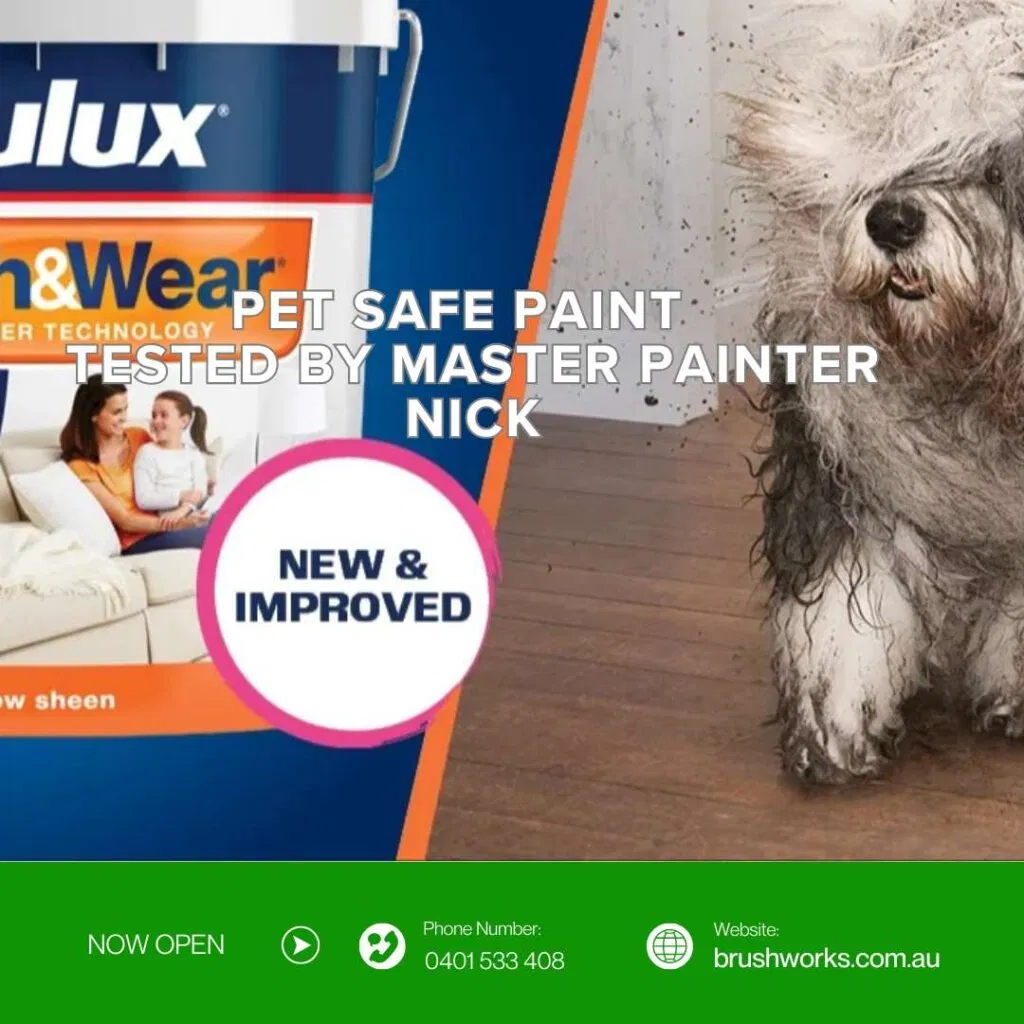
Why VOCs in Paint Are Dangerous for Dogs and Cats
VOCs, or volatile organic compounds, are chemicals that evaporate into the air as paint dries. They’re found in conventional solvent-based paints and even in some water-based products at elevated levels.
For Sydney pet owners, the key facts about VOCs are:
- Dogs can smell up to 100,000 times more acutely than humans, meaning they detect VOC fumes at concentrations humans can’t perceive
- Cats groom themselves continuously, meaning any chemical residue on fur or paws gets ingested directly
- Birds and small animals have delicate respiratory systems that are extremely sensitive to airborne fumes and can experience distress at VOC levels that barely affect dogs
- Pets spend most of their time at floor level, where heavier VOC molecules concentrate and linger longest after painting
- Smaller body mass means pets absorb a proportionally higher chemical load from the same environment
What Symptoms Do VOCs Cause in Pets?
Recognising paint-related symptoms in your pet early can prevent serious harm. Watch for these signs during or after any painting project in your Sydney home.
| Symptom | Possible Cause | Action Required |
|---|---|---|
| Sneezing or coughing repeatedly | VOC inhalation, respiratory irritation | Remove pet immediately, ventilate room |
| Watery eyes or eye redness | Chemical irritation from paint fumes | Fresh air, monitor closely |
| Vomiting or lethargy | Ingestion of wet paint or solvent residue | Veterinarian immediately |
| Excessive drooling | Licking or ingesting paint | Veterinarian immediately |
| Dizziness or disorientation | High VOC exposure in enclosed space | Fresh air urgently, veterinarian |
| Skin irritation or fur loss | Direct contact with wet conventional paint | Wash affected area, veterinarian if severe |
Traditional oil-based and solvent-based paints can contain formaldehyde, benzene, toluene and heavy metal compounds. These cause serious health problems in animals with prolonged exposure, not just temporary sneezing.
What Actually Makes a Paint Pet Safe?
The term pet safe paint isn’t regulated in Australia, which means any brand can print it on their tin without meeting a specific standard. Here’s what to actually look for on the label.
Low VOC vs Zero VOC: What’s the Difference?
Understanding VOC classifications helps you make a genuinely informed choice rather than trusting marketing language alone.
| Classification | VOC Level | Pet Safety Level |
|---|---|---|
| Conventional paint | Over 200 grams per litre | Not recommended for pet homes |
| Low VOC paint | Under 50 grams per litre | Safer, acceptable with ventilation |
| Zero VOC paint | Under 5 grams per litre | Safest option for pet households |
| Natural mineral paint | Near zero, no synthetic solvents | Best for highly sensitive animals |
One critical point that most Sydney paint retailers won’t tell you: low odour does not mean low VOC. A paint can have a faint smell and still contain significant VOC levels. Always read the technical data sheet, not just the front label.
What Ingredients to Avoid in Paint Around Pets
When checking paint labels for your Sydney home with pets, avoid products containing these specific chemicals:
- Formaldehyde: Common preservative in conventional paints, causes respiratory irritation in pets
- Benzene: Linked to blood disorders, found in some solvent-based paints
- Toluene: Nervous system disruptor, common in oil-based products
- Ethylene glycol: Highly toxic to cats and dogs if ingested, causes kidney failure
- Heavy metals: Lead, mercury and cadmium, still found in some imported paints
- Isothiazolinones (MI and MIT): Preservative compounds that cause allergic reactions in sensitive animals
What to Look for on the Label Instead
- Zero VOC or ultra-low VOC classification confirmed on the technical data sheet
- Water-based acrylic or natural mineral base, not oil-based or alkyd formula
- Free from formaldehyde, lead and heavy metals confirmed on Safety Data Sheet
- Third-party certifications including Green Seal, GREENGUARD Gold or equivalent
- Explicit non-toxic labelling with ingredient transparency from the manufacturer
Best Pet Safe Paint for Every Room in Your Sydney Home
Different rooms in your Sydney home present different challenges for pet safe painting. Here’s what Brushworks Painters recommends by room type.
Best Pet Safe Paint for Bedrooms
If your dog or cat sleeps in your bedroom, it’s the most critical room in the house to get right. Pets spend 8 to 14 hours per day in sleeping areas, meaning prolonged low-level VOC exposure accumulates faster here than anywhere else.
Best choices for dog safe paint and cat safe paint in Sydney bedrooms:
- ECOS Paints Interior Emulsion: zero VOC, no odour, used in nurseries and animal shelters
- Dulux Low VOC Interior: reliable low emission formula, widely available across Sydney
- Bio Paints Natural Mineral Paint: plant and mineral-based, no synthetic chemicals
- Taubmans Endure Interior: low odour acrylic, washable finish for pet hair and smudges
Best Pet Safe Paint for Living Areas
Living rooms and open-plan areas need pet friendly paint that’s both low emission and genuinely durable. Your dog’s tail is going to hit that wall approximately 4,000 times this year.
The right non-toxic paint for pets in living areas must also handle real-world pet mess:
- Choose a satin or eggshell finish for washability, flat finishes absorb pet stains permanently
- Opt for mid-tone neutral colours that hide paw prints, fur smudges and nose marks between cleans
- Consider painting the lower 900mm of walls in a scrubbable low VOC paint for the high-contact zone
- Avoid bright whites in pet households as every mark shows immediately on a pale background
Best Pet Safe Paint for Pet Rooms and Kennels
Paint safe for kennels and pet rooms needs to be the most robust and chemical-free option in your toolkit. Pets spend concentrated time in these spaces and the surfaces are cleaned frequently with water and disinfectants.
Best options for pet room and kennel painting in Sydney:
- ECOS Pet Dwellings Paint: specifically formulated for dog houses, kennels and animal enclosures, zero VOC gloss finish
- Dulux Wash and Wear Low VOC: highly washable surface, resists frequent cleaning
- Taubmans Endure: scrub-resistant, low odour, handles disinfectant cleaning cycles
Best Pet Safe Paint for Bathrooms and Laundries
Bathrooms and laundries in Sydney pet homes need mould resistant, low VOC paint that handles the combined moisture from showers and the occasional dog bath.
- Choose a zero VOC mould-resistant formula to prevent chemical mould treatment products being needed later
- Satin or semi-gloss finish allows wiping down wet paw prints and splashing from pet bathing
- Dulux Wash and Wear Low VOC and Taubmans Endure Interior both perform well in Sydney pet bathroom conditions
Which Paint Finish is Best for Homes with Pets?
Paint finish choice is genuinely important in pet households. The wrong finish turns every paw print, nose smudge and claw mark into a permanent feature of your walls.
Paint Finish Comparison for Pet Households
| Finish | Washability | Pet Suitability | Best Use |
|---|---|---|---|
| Flat, Matte | Poor, stains absorb | Not recommended | Ceilings only in pet homes |
| Eggshell | Good, gentle wiping | Good for low-traffic rooms | Bedrooms, dining rooms |
| Satin | Very good, handles scrubbing | Excellent all-round choice | Living rooms, hallways |
| Semi-Gloss | Excellent, fully washable | Best for high-contact zones | Skirting boards, trims, kennels |
| Gloss | Maximum washability | Best for pet rooms | Dog rooms, kennels, doors |
The professional recommendation from Brushworks Painters for Sydney homes with dogs and cats is satin finish as the default wall paint. It’s washable enough for real pet mess, reflective enough to look sharp under lighting and forgiving enough to hide minor surface imperfections on older Sydney plaster walls.
How to Paint Your Sydney Home Safely When You Have Pets
Even the best zero VOC pet safe paint requires correct process management to keep your animals genuinely safe during a painting project. The product is only half the equation.
Before Painting: Preparation Steps for Pet Owners
- Arrange for pets to stay with a friend, family member or pet sitter on painting days if at all possible
- Confine pets to the opposite end of the home from the rooms being painted
- Remove pet bedding, bowls, toys and any surface your animal touches from the painting area
- Cover aquariums and bird cages completely, fish and birds are highly sensitive to airborne particles and even low VOC fumes
- Brief your painter on the pet situation so they maintain closed doors during application
During Painting: Ventilation and Safety
- Open all windows and doors in the painting area to maximise cross-ventilation throughout the project
- Use fans to actively move air through the space and accelerate off-gassing
- Keep lids on paint tins at all times when not actively decanting
- Clean brushes and rollers immediately, never leave rinse water accessible to pets, they’re attracted to the smell
- Store all paint equipment, solvents and cleaning agents in a locked or pet-inaccessible space
After Painting: When Can Pets Return to the Room?
This is the question Brushworks Painters gets asked most often by Sydney pet owners. Here’s the honest answer by paint type.
- Conventional paint: Minimum 72 hours before pet re-entry, longer in poorly ventilated rooms
- Low VOC acrylic paint: 24 to 48 hours after the final coat is fully dry to touch
- Zero VOC paint: 12 to 24 hours after drying, once any residual odour has cleared
- Natural mineral paint: Generally safe once dry, a few hours for most pets with good ventilation
Remember that dry to touch is not the same as fully cured. Paint continues to off-gas during the curing period, which takes 2 to 4 weeks for full chemical stabilisation regardless of VOC level.
“At Brushworks Painters, we specify zero VOC or ultra-low VOC paint systems on every Sydney project where pets are living in the home. Dulux’s own product data confirms their low VOC interior range emits under 5 grams of VOC per litre, which is the safest classification available. Master Painters Australia guidelines recommend all interior painting in occupied pet homes use water-based, low emission products as standard practice. The cost difference between a conventional paint and a quality zero VOC formula is approximately $8 to $15 per litre. That is genuinely the cheapest pet insurance you will ever buy.”Nick Kyriaco
Master Painter & Founder, Brushworks Painters Sydney
Licensed Interior Painting Specialist | Master Painters Australia Member | 20+ Years Sydney Experience
Best Paint Colours for Sydney Homes with Pets
Safety is the first consideration. Practicality is the second. Here’s how to choose pet friendly paint colours that stay looking fresh between professional repaints.
Colour Tips for Pet Owners
- Avoid bright white walls near pet entry points, every muddy paw print becomes a feature
- Choose warm neutrals like soft grey, warm beige, sage green or olive, smudges and fur blend naturally
- Dark feature walls in charcoal or deep green work well in pet households as they hide wear patterns from leaning and rubbing
- Mid-tone colours are the professional sweet spot, light enough to feel fresh, dark enough to hide daily pet mess
- Touch-up friendly colours in simple neutral tones allow spot repairs without visible patch marks
Dogs and cats see the world primarily in blues and yellows, so all those agonising colour decisions you make are, frankly, entirely for your own benefit. Choose wisely anyway, you’re the one who has to look at it.
Frequently Asked Questions: Pet Safe Paint in Sydney
What paint is safe for pets indoors in Australia?
Zero VOC and low VOC water-based acrylic paints are the safest choice for Australian homes with pets. Look for products like ECOS Paints, the Dulux Low VOC interior range and Taubmans Endure Interior. Always check the technical data sheet for confirmed VOC levels under 5 grams per litre for the safest classification, and avoid any product containing formaldehyde, ethylene glycol or heavy metal compounds.
How long before pets can re-enter a freshly painted room?
For zero VOC paint, allow 12 to 24 hours after the final coat dries before pets re-enter with good ventilation. For low VOC acrylic paint, allow 24 to 48 hours. For conventional paints, a minimum of 72 hours is recommended. Paint continues to off-gas during curing for 2 to 4 weeks, so maintaining ventilation after re-entry remains important regardless of the paint type used.
Is low odour paint the same as low VOC paint?
No. Low odour does not mean low VOC. A paint can have very little smell and still emit significant VOC levels that affect pets. Always read the technical data sheet rather than relying on front-label marketing language. Look for confirmed VOC content in grams per litre. Under 50 grams per litre is low VOC. Under 5 grams per litre is zero VOC and the safest option for Sydney pet homes.
What paint finish is best for homes with dogs and cats?
Satin finish is the professional recommendation for pet friendly wall paint in Sydney homes. It’s washable enough to handle muddy paw prints and nose smudges, durable enough to resist scratching and claw marks and not so reflective that it highlights every surface imperfection on older Sydney plaster walls. Semi-gloss is the better choice for high-contact zones, skirting boards and pet room surfaces that need frequent cleaning.
Can paint fumes harm birds and small animals?
Yes, significantly. Birds and small animals including rabbits, guinea pigs and reptiles have extremely delicate respiratory systems that are far more sensitive to paint fumes than dogs or cats. Even low VOC paint fumes can cause distress in these animals. Always remove birds and small animals completely from the property on painting days, not just to another room. Only return them once the space has been fully ventilated and any residual odour is completely gone.
Is water-based paint automatically safe for pets?
Not necessarily. Many water-based paints still contain VOCs, preservatives like isothiazolinones and other chemicals that affect pets. Water-based simply refers to the carrier medium, not the chemical content. Always check the VOC classification and ingredient list on the Safety Data Sheet. The safest water-based options are those certified as zero VOC with confirmed absence of formaldehyde and heavy metals.

About Nick Kyriacou As founder of Brushworks, I bring 25+ years of painting expertise to every Sydney project. We specialise in commercial painting, industrial, and premium residential painting with meticulous attention to detail. Keep up to date with our latest news and blog
